 |
 | | |  |  |  |  |  |  |  | Locate a Doctor |  Find a local doctor in your area code. Consider a consultation. |
|  |
|  |  |  |  |  |  |
|  |  | | 
 | | |
 |  | | See important TERMS AND CONDITIONS OF USE for disclaimers and other information. Any use of this site constitutes your agreement to these Terms and Conditions. | |  |  |
|
 |
 |
Sperm Bank: Information and National Directory |
Sperm Banking may play an important role in a couple's decision when considering a vasectomy or
a reversal.
|
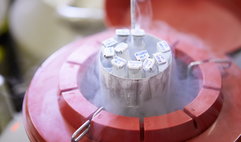
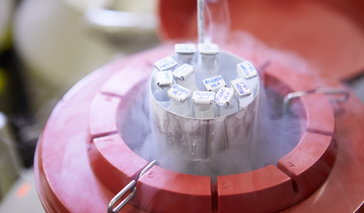
Sperm Banking is the collection, freezing (cryopreservation)
and storage (cryobanking) of healthy sperm, usually during or after vasectomy
reversal surgery or prior to vasectomy. You should discuss these options
with your physician. At the time of a vasectomy, sperm banking allows couples
to have dependable sterility now, as well as "banking" sperm for the possible
future option of having children. At the time of a vasectomy reversal, sperm
aspiration and banking provides an alternative if the reversal is not effective
and the couple may later consider Assisted Reproduction Techniques (ART)
such as artificial insemination, in vitro fertilization and sperm microinjection.
Sperm Banking may also be done after vasectomy reversal, in case the reversal
fails later.
|
|
Search the SPERM BANK DIRECTORY:
Click on a state to search for Sperm Bank
information.
Your Directory Search Results will present
Sperm Bank information for that state as well as other states in that
region.
|
Cryopreservation and cryobanking simply involve freezing - at very low temperatures-and storing living
tissue such as healthy, viable sperm. Sperm specimens may be frozen for years but only half of the sperm
cell specimens may prove motile, or fertile, after emerging from their frozen state.
To begin this entire procedure, you will need to set an appointment with the laboratory or sperm
bank facility before your vasectomy or vasectomy reversal in order to have your case and
medical history reviewed. Infectious disease blood tests for hepatitis, HIV, and syphilis may be
required by the sperm bank prior.
Sperm Banking with a Vasectomy
Annually, approximately 600,000 American men opt for vasectomy. However, couples can have a change
of heart, or a man may regret an earlier vasectomy if he later remarries. As many as 30,000 to 50,000 men have a vasectomy reversal each year.
While success factors for restoring fertility after vasectomy are good, in many situations it may
not be a "sure bet," especially if the vasectomy is several years "old." That's why sperm banking
before a vasectomy is an option worth evaluating.
The specimens that will be preserved can be collected at the laboratory, or when this isn't convenient or practical,
the collection can be done at home and shipped to the facility using special packaging when the facility can handle
shipping.
Sperm may be banked from one ejaculation or 'collection', which provides the lab with one to six
vials of specimen material. It is often recommended that you plan on banking more than a single
collection. To build up your sperm count, it is ideal to wait at least two days between collections.
Sperm Banking with a Vasectomy Reversal
When sperm banking is desired at the time of a vasectomy reversal, there are three different sources
that the sperm may come from.
- If the fluid from the vas deferens below the vasectomy scar has living
sperm, then this fluid will usually be collected.
- If however a vaso-epididymostomy is performed, and the fluid from the connection site of the epididymis has living sperm, then this fluid will usually be collected.
- If fluid from the vas deferens has degraded or has non-living sperm,
a vasovasostomy connection will still likely be successful, and in that
case sperm may be collected directly from a small piece of tissue taken
right out of the testicle. An embryologist receives the specimen and
performs the actual tissue processing. This sperm can only be used with
IVF (in vitro fertility) and ICSI (intractoplasmic sperm injection).
This sperm cannot be used for artificial insemination. Only frozen ejaculated
sperm can be used for artificial insemination.
Some Cost Factors:
The costs of assisted reproduction and sperm banking are generally are not covered by insurance.
Private laboratories, hospitals and university medical centers provide these services - and prices for individual services differ. Sperm banking facilities typically charge several hundred dollars to process the specimen for freezing, and then a few hundred dollars per year for storage of the sperm.
Sperm Bank Accreditation:
The costs and procedures involved in cryopreservation and sperm banking are of little concern if you can't count on the quality and medical integrity of the services and facility you choose. That's why it is important that you check the accreditation of your sperm bank or assisted reproduction laboratory.
Universities and state and federally funded sperm banking programs must meet rigorous professional and
regulatory standards, inspections and certifications.
These include CAP (College of American Pathologists) CLIA (Clinical Laboratory Improvement Act),
COLA (Commission on Office Laboratory Accreditation), AATB (American Association of Tissue Banks),
the American Society for Reproductive Medicine and other organizations.
See USEFUL LINKS page.
Is Sperm Banking Right for You?
The great majority of men undergoing vasectomy reversal never require the use of sperm frozen
at the time of surgery. For these men, the additional expense of banking the sperm proves unnecessary.
Patients at higher risk of lessened technical success (such as a redo vasectomy reversal) would
more likely benefit despite the additional cost.
While it's important to consider this option at the time of a vasectomy reversal, there are cautions.
Sperm banking cannot guarantee successful conception and pregnancy, it cannot guarantee a healthy
child, and it cannot genetically manipulate any physical or mental characteristics for a child
conceived in this manner.
Nonetheless, sperm banking offers a back-up plan when considering vasectomy or reversal.
Certainly, it can be a good idea to plan for contingencies when considering sterilization today, and
potential reversal in the future. The fact is many couples never resort to using frozen sperm.
But like anything valuable, it's nice to have it in the bank, "just in case."
In Summary:
- Sperm banking is important for a couple to evaluate as they consider
a vasectomy reversal.
- Cost of assisted reproduction and sperm banking are generally not covered by insurance.
- It is important to check the accreditation of your sperm bank.
|
Other Useful Articles
Alternatives - Find out how the vasectomy procedure compares with alternative methods of contraception available today.What If We Have a Change of Heart? - Lives and feelings change - can a vasectomy surgery be reversed?Locate a Sperm Bank by State - Search the Vasectomy.com directory for sperm bank facility in your state.Methods of Contraception - Comparison Chart - See which form of contraception is right for you with our easy to understand, side-by-side contraceptive comparison.How Much Will This Cost? - Learn how vasectomy costs compare to other contraceptives and discover ways to make this procedure fit your family budget.
Visit our Site Map to see everything about the vasectomy procedure that our site has to offer.
|
[Last Modified: 03/04]
|
 |